How AI Reviewers Handle Complex Git Diff Context
Reviewers miss bugs from diff size or search scope, and each needs a different fix.
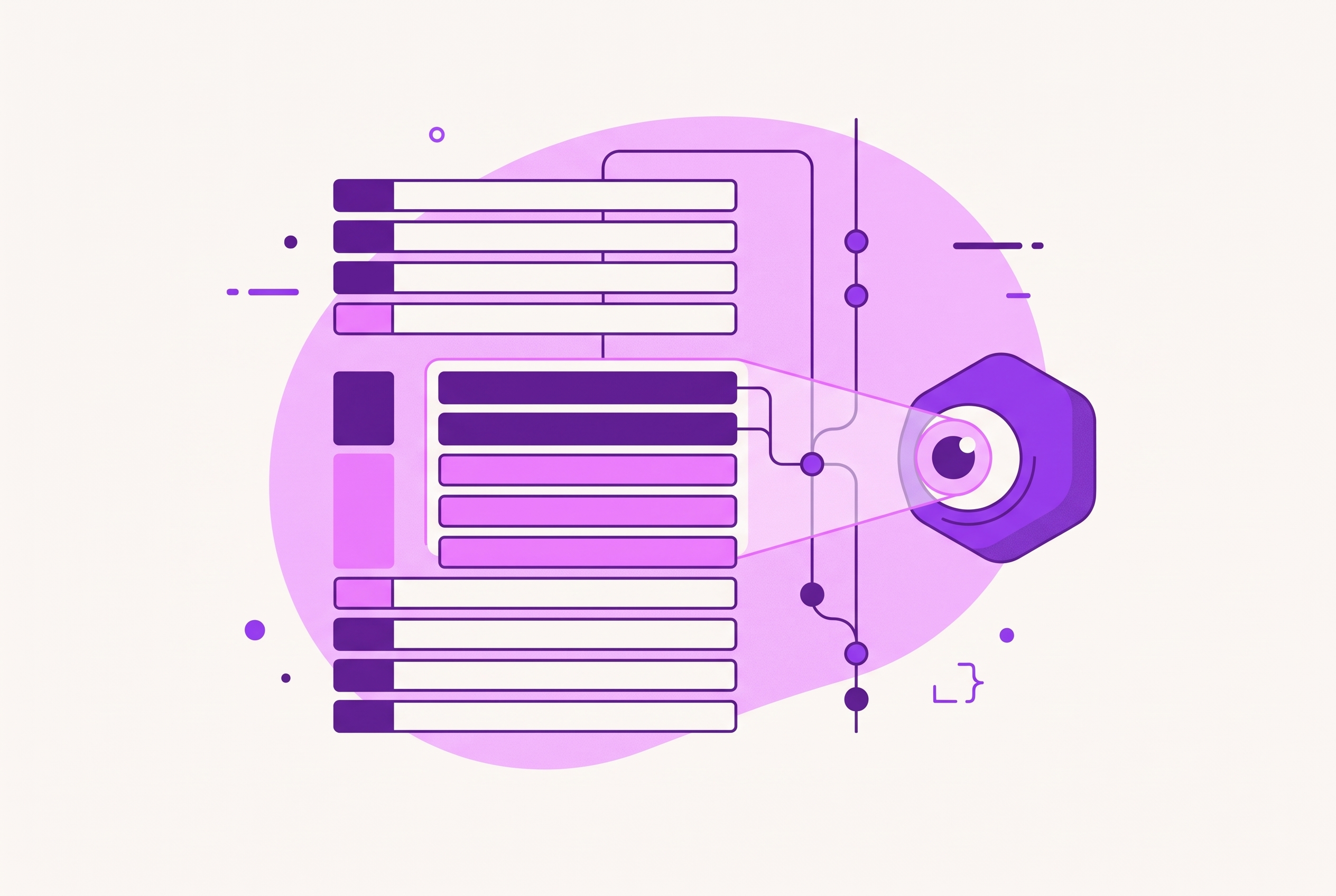
AI reviewers handle complex Git diffs under two distinct constraints. Size determines how much of the change they can read, while scope determines how far beyond it they look for supporting evidence. Either limit can cause the reviewer to miss a bug. Distinguishing them is the basis for choosing a remedy that improves review.
Why AI reviewers fail in ways that look identical but have different causes
An AI reviewer reports what it found, but an important bug slips through. The natural diagnosis is that it lacked context. That diagnosis is incomplete. It does not distinguish evidence the tool never reached from evidence it was never going to fetch, although those failures require different fixes.
A lockfile regeneration touching thousands of files is large and simple, while a 20-line change to an error code that a downstream service matches on is small and architecturally complex. The first presents a size problem, the second a scope problem. Reading more changed lines can help with the lockfile, but it cannot reveal an absent downstream consumer. Processing an oversized diff remains a separate constraint even with access to that consumer.
How the default diff format systematically strips the context a reviewer needs
Git’s default diff includes three lines of context above and below each hunk. That is a thin starting point for review. It does not reliably expose the enclosing function, its callers, or relationships across files, so the reviewer receives changed text without much of the structure that explains its meaning.
The LAURA paper on LLM code review identifies this missing context directly and extends each hunk to the enclosing function or method boundary, capped at three times the original diff length. That approach restores local structure within a bounded expansion. It does not supply every relevant relationship elsewhere in the system. A tool that neither widens nor supplements the raw diff compounds the format’s weakness by making that fragment the boundary of its review.
The size constraint: what happens when a diff exceeds what the tool will read
Every AI reviewer has a finite token budget. Context windows limit how much material can be processed, and larger windows raise that finite limit. When a tool truncates an oversized diff, the omitted portion is effectively nonexistent for that review. The resulting findings may still look complete. Unlike a linter that reports what it skipped, a silently truncating reviewer gives the reader no clear distinction between unexamined code and code with no findings.
Large monorepo pull requests make this constraint visible because they can touch dozens of files. AI-generated code adds to the load by making broader changes to backend logic, configuration, tests, and user-facing components within a single change. A reviewer may have enough capacity to understand each part separately but not enough to process the submitted change as a whole.
This creates a misleading absence of evidence. Findings in the retained portion can make the review appear substantive even though other sections received no scrutiny. A larger effective context window can reduce that exposure, but it cannot make input size irrelevant. Operationally, the relevant measure is how much of the actual diff the tool processed.
The scope constraint: what the tool will not go look for even when the diff fits
A reviewer can read every changed line and still miss the critical bug. The missing evidence may be a caller in another file, a contract in another service, or a configuration value elsewhere in the repository. Nothing has been truncated in that case.
The 20-line error-code change illustrates this boundary precisely. Its local implementation may be coherent, while the downstream service still matches on the old value. Perfect comprehension of the diff cannot expose a consumer that is absent from it. Scope therefore describes whether the reviewer consults only the diff, the surrounding repository, or multiple repositories and services.
CodeAnt AI’s 2026 analysis describes how diff-only tools in 2023–2024 missed shared-request-schema changes that broke downstream services, which required persistent system context to catch. Red Hat’s open-source ai-code-review CLI likewise starts from the assumption that analyzing only the diff usually provides insufficient context. A large change that stands on its own can need less context from elsewhere than a tiny edit to a cross-service contract.
How tools are architecturally split between diff-only and codebase-aware approaches
Diff-first tools make review fast and low-friction by starting with the change delivered through the pull request. A strictly diff-only approach avoids a separate codebase-indexing step, but it cannot ground findings in cross-file consequences that are absent from its input. The architectural distinction determines what evidence the tool can use, regardless of how fluently it explains the changed code.
GitHub Copilot Code Review now uses an agentic architecture that pulls in repository context beyond the diff, so it should not be treated as strictly diff-only. GitHub still says that Copilot may miss problems, especially when changes are large or complex. Broader access is not a guarantee of complete review.
Greptile represents the graph-indexed approach, building a semantic graph of the repository before the first review and running parallel agents against that broader context. This can ground a suggestion in a specific existing helper. The upfront index has a cost. First reviews on a large monorepo arrive after a delay that diff-only tools avoid.
CodeRabbit takes a middle position by assembling context at review time without an equivalent persistent-index build step. Its sources include linked issues, repository conventions, prior feedback, and related repositories. CodeRabbit Essentials is priced per developer per month billed annually and is free on public repositories. These approaches differ in when and how they obtain evidence, but none makes the volume of material or the selection of relevant context disappear.
The first presents a size problem, the second a scope problem.
Why monorepos expose both constraints at once and make the interaction visible
Monorepos combine broad diffs with relationships that extend beyond the edited files. They expose both limits at once. Reading more of a large change consumes capacity, while understanding its consequences may require still more supporting material from elsewhere in the repository. Size and scope therefore compound rather than simply coexist, making monorepos a demanding test of a reviewer’s architecture.
Salesforce engineering reports that code volume increased by roughly a third after AI adoption, while pull requests regularly expanded across many files and substantial lines of change. Salesforce also reports that full analysis of large pull requests, including grouping, recommendations, and security checks, can take up to five minutes. The case grounds the problem in review workload. More code arrives together, and a useful analysis must do more than inspect isolated edits.
Stacked pull requests, the approach Graphite is built around, ease this pressure by splitting changes into smaller pull requests in a sequence, each of which goes through review on its own. Scope remains a separate obligation. Each small pull request may still depend on a contract or consumer outside its changed lines, so a stack cannot substitute for cross-service context.
What false positives reveal about the limits of expanding context
Expanding context is not a free improvement in review quality. Widening hunks, indexing a codebase, and increasing the context window give the reviewer more evidence, but also more material to confuse. Relevance is the limiting distinction. Irrelevant monorepo files can support confident non-issues while the reviewer still misses the cross-service dependency that explains the real failure.
A July 2026 preprint studying CodeRabbit comments across a large set of repositories found that developers rejected a majority of agentic reviews, with false positives the largest reason given. That finding complicates the case for simply increasing recall. Catching more real issues helps little if the noise that comes with them teaches developers to ignore the review. A wrong comment can then make developers pay less attention to later findings.
Google’s internal standard for a code-review check requires less than one-in-ten effective false positives, defined as findings developers did not act on. That sets a concrete usefulness benchmark. CodeRabbit’s July 2026 “Source line” feature helps developers assess whether a review comment is trustworthy by tracing it to the exact guideline or linked repository that triggered it. Such provenance lets developers evaluate the basis of a finding, rather than judging only the confidence of its wording.
Adversarial inputs and volatile provider limits as emerging threats to both constraints
Context can be manipulated as well as omitted. Research on adversarial framing found that one-shot attacks defeated GitHub Copilot in a minority of cases, while iterative attacks against Claude Code succeeded in the large majority of cases in real project configurations. The different attack settings are important to that comparison. Redacting metadata restored detection, showing that review quality can depend on both the code’s availability and how surrounding material frames it.
A reviewer must interpret the material it consults without allowing misleading framing to displace relevant evidence. More access alone cannot provide that protection. HalluJudge, a reference-free hallucination-detection approach for context misalignment in code review, is a research signal that the field treats this as a distinct problem.
The effective context allowance can shrink without warning, so an assumption made when a tool was configured may no longer describe what it can process. Where that allowance changes, a previously manageable diff can cross the truncation boundary without becoming larger. When checking why findings were missed, teams should validate limits at runtime as well as read the setup-time documentation.
How to diagnose which constraint is binding before choosing a remedy
Teams should check whether the missed finding was in files the reviewer read or in sections it never reached. They should also compare whether large pull requests receive thinner reviews than small ones containing equivalent logic, and whether the effective context limit is documented and validated at runtime. Those questions test size directly. A larger advertised window is not evidence that the entire submitted diff was read.
Scope requires a different test of sufficiency. Teams should establish whether the missed finding depended on a caller, consumer, or configuration value outside the changed files, and whether perfect comprehension of the diff alone could have exposed it. A pattern of escaping cross-file or cross-service bugs strengthens that diagnosis. The key distinction is whether relevant evidence was omitted from processing or absent from the reviewer’s reach.
For size failures, the remedies are stacked pull requests, larger effective context windows, or isolated pull requests for large automated changes such as lockfile regenerations and dependency bumps. For scope failures, the remedies are graph-indexed or system-aware reviewers, supplementary architecture documents and API contracts, or instructions naming the cross-service relationships to check. Where both bind, the order is structural intervention first and scope tooling second. An indexed codebase does not prevent an oversized diff from being truncated.
Both remedies need the same false-positive check. Measuring findings developers do not act on helps distinguish useful coverage from noise that teaches the team to ignore review. Qodo’s 2026 evaluation frames the outcome in terms of shorter review cycles while incident rates stay flat or fall.
Sources
- Scaling Code Reviews: Adapting to a Surge in AI-Generated Code
Supplied the figures on code volume growth after AI adoption and the up-to-five-minute analysis time for large pull requests.