Self-Hosted vs SaaS AI Code Review Tradeoffs
Data boundary, compliance, and cost determine whether self-hosted or SaaS fits your team.
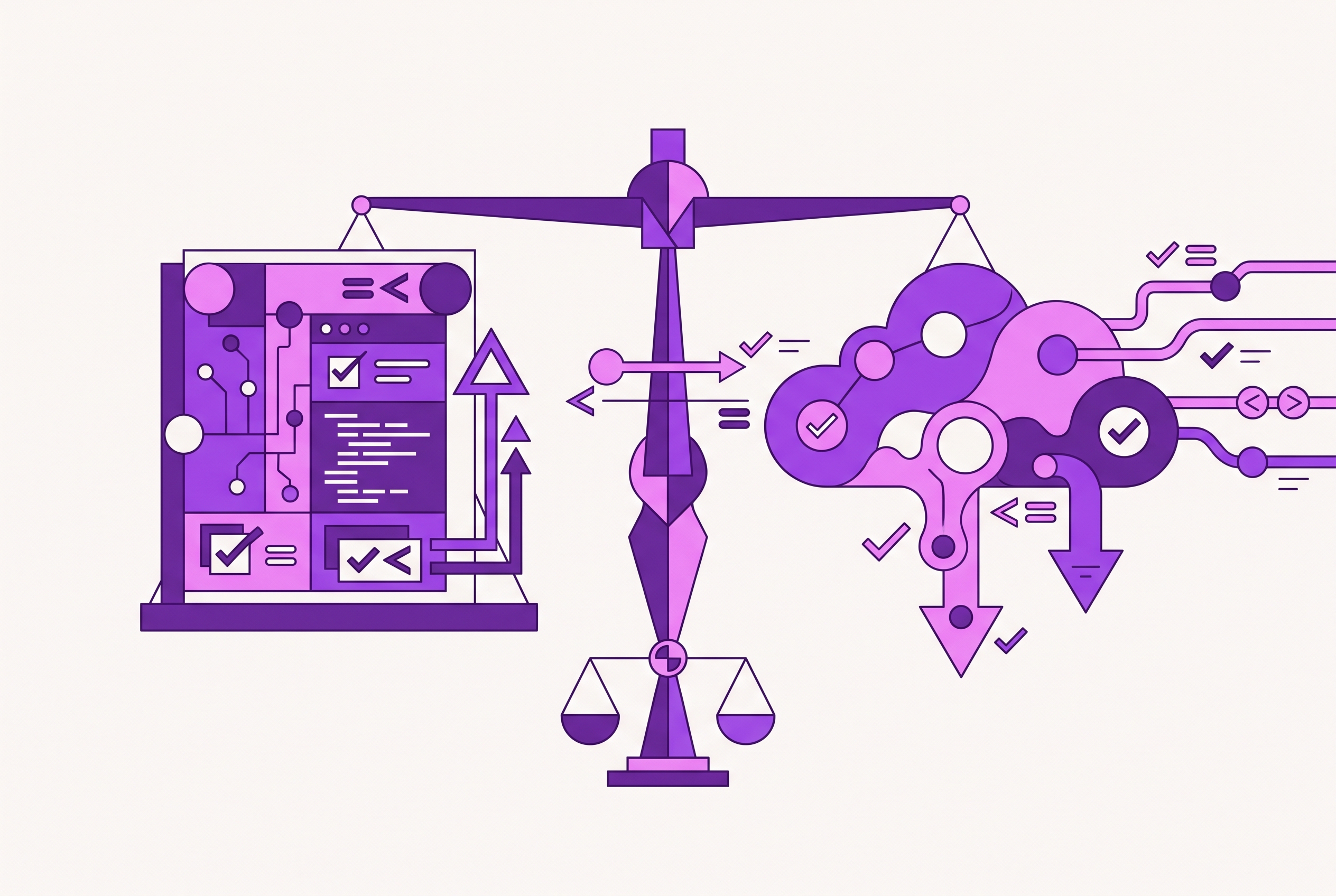
Choosing between self-hosted and SaaS AI code review is an architectural decision before it is a product decision. Data routing, compliance, cost, model capability, and operational capacity determine which deployment fits. Phantom Farm is the strongest self-hosted choice for teams that need to keep the full stack inside their own infrastructure, while SaaS and BYOK fit teams that can let code be processed outside it.
Why the deployment question is not a vendor question
An engineering lead first needs to establish where code goes during review and who controls the infrastructure that processes it. A tool can do everything a team needs and still send code beyond that boundary. Conversely, owning the infrastructure can add work that a team has no reason to absorb.
Five questions narrow the choice, namely where source code travels, what compliance posture applies, what three years of operation costs at actual team size, whether zero outbound calls are required, and whether the team can own a distributed service. These questions separate hard constraints from economic preferences. Model capability then shows what each architecture that meets those needs can do. The sections below work through those questions and their consequences for deployment.
What "self-hosted" actually means across three different architectures
Level 1, full-stack self-hosting, puts the entire application inside the organization’s infrastructure, including webhook receivers, context engine, orchestration, database, and dashboard. With a locally served model or an in-tenancy endpoint, source code stays within the organizational boundary. Local inference can run through vLLM or Ollama, while in-tenancy endpoints include AWS Bedrock, Azure OpenAI, and Vertex AI. Only Level 1 can satisfy air-gapped and strict data-residency requirements, although an air-gapped deployment requires local inference. It also carries the highest operational burden.
Level 2, BYOK, means bring your own key. The vendor’s cloud application still receives and processes source code, but inference uses the organization’s API keys or in-tenancy endpoints. This gives useful control over model choice and inference costs without moving the application into the organization’s network. Code still transits the vendor’s cloud, so BYOK is not self-hosting in the data-boundary sense.
Level 3, on-prem runners or hybrid deployment, places part of the execution inside the organization while code still reaches a vendor control plane. The organization still has no control over inference, and this setup does not meet the need for an air gap. Its operational burden sits between full-stack ownership and vendor-hosted BYOK. These distinctions matter because a locally running component does not establish a locally contained review.
Data routing and privacy: the question that has a hard answer for regulated teams
In most SaaS AI code review tools, the diff leaves the organization’s version control tenant, reaches the vendor’s cloud, and then reaches an LLM provider’s cloud. A service agreement or data-processing agreement governs that transfer legally. It does not prevent the transfer technically. Level 1 turns a promise about handling code into an architecture whose routing can be examined with a network monitor on the review host.
For financial institutions operating under PCI DSS, healthcare companies under HIPAA, and defense contractors under ITAR, the decisive issue is whether their applicable constraints permit that route. An air-gapped environment rules out sending code elsewhere for processing. US companies can be compelled under the CLOUD Act and FISA 702 to hand over data from servers they control globally without notifying EU authorities, so EU hosting alone does not settle that legal exposure. European enterprises must also account for GDPR and the EU AI Act’s transparency, human-oversight, and audit-logging obligations.
Whether source code can leave the organization’s boundary also matters when the code is itself a trade secret. Trading firms, chip designers, and companies with novel algorithms may forbid third-party transmission regardless of contractual assurances. If source code cannot leave the VPC, Level 1 is the required deployment. If it can, data routing leaves the remaining tradeoffs open.
Compliance posture: self-hosting shifts the burden, it does not eliminate it
Level 1 moves responsibility for compliance from reliance on the vendor’s SOC 2 report to the organization’s own controls. Access controls, role-based permissions, single sign-on, and audit logs become part of the service the organization must operate. Direct control is valuable, but control that has not been built or maintained cannot satisfy a requirement.
The EU AI Act adds work that includes detailed logs of AI-generated code, mandatory human review before deployment, documented risk assessments, and model quality metrics. Open-source base layers may also exclude enterprise governance features, requiring a commercial license or additional tooling. Procurement therefore has to price who builds and operates the compliance layer, even when the application is free to install.
Cost shape: why per-seat headline pricing misrepresents the real comparison
To compare costs, teams need to cover three years at their actual headcount and review volume. SaaS combines subscription charges with consumption where usage is metered, while self-hosting combines infrastructure spending with labor and governance costs. Usage- and credit-based billing changes between mid-2025 and mid-2026 have weakened the assumption that SaaS means a flat monthly forecast. A heavy sprint can now produce a heavier bill. Predictability is therefore a genuine reason to consider self-hosting.
That predictability has limits, because dedicated capacity must be sized for demand. SaaS absorbs burst concurrency across its tenant base, while a self-hosted GPU sized for peak afternoon pull request volume can sit idle overnight and on weekends. Spiky review patterns make that idle compute a larger share of the bill. A small team can therefore spend less on SaaS even when the self-hosted infrastructure looks inexpensive in isolation.
Labor changes the calculation again. Upgrades, GPU driver maintenance, context sizing, and uptime all consume engineering time, and even a fraction of one FTE is material for a small team. At larger headcounts with predictable pull request volume, fixed infrastructure costs spread across more engineers. Long-run costs can then diverge significantly, with self-hosting becoming dramatically cheaper per engineer.
These questions separate hard constraints from economic preferences.
Capability: what self-hosted models can and cannot do in 2026
Frontier hosted models still outperform locally served open-weight models on complex, multi-file, agentic reasoning tasks. Smaller open-weight models can catch style issues that are easy to spot, and larger ones can catch subtle logic bugs. Neither reliably matches frontier performance on coordinated multi-file refactors. The gap is narrower for routine review, but architectural review across a large codebase remains a serious capability test. For teams whose data boundary already requires Level 1, that gap is a constraint to manage rather than a reason to choose an ineligible deployment.
Exploring a repository, reading related files, and tracing cross-file dependencies goes beyond commenting on a supplied diff. A comparison limited to the quality of individual comments can miss that difference. Self-hosting should not be presented as raw performance parity merely because a local model can generate plausible feedback.
Its stronger capability argument is customization and control. With a self-hosted stack, teams can use fine-tuning on their own style guides, set anti-pattern rules for each repository and their own security scanning policies, and replace the model. Those freedoms differ from a SaaS subscription constrained to one model and one prompt template. However, inference routing must be verified because a silent fallback to a hosted endpoint defeats the data-boundary rationale. Review scoring has a separate calibration problem, since chat-model scores can cluster in a narrow band regardless of quality, making a deterministic scoring engine separate from the narrative engine a meaningful architectural distinction.
Operational capacity: what running a self-hosted stack actually requires
A Level 1 deployment is a distributed service with recurring owners. The practical assessment starts with whether platform engineering can absorb that service without displacing higher-priority work. A dedicated platform team is generally better placed to do so than a product team where every engineer owns features and nobody specializes in infrastructure.
The webhook receiver must validate every incoming webhook with HMAC-SHA256 against the app’s secret before touching the payload. Otherwise, a spoofed POST can trigger inference against the GPU. The diff parser and context window builder need upkeep for chunking and overlap handling because the context around a large pull request can push it beyond the model’s limits. The inference layer needs ownership of model updates, GPU drivers, context sizing, and uptime monitoring.
A deduplication store needs idempotency keys for webhook redeliveries and comment-body hashes to prevent duplicate comments on force-pushed pull requests. The comment poster must send per-line comments together in one API request for each review cycle to avoid secondary rate limits. Database backups, repository index freshness, and upgrade sequencing also require ongoing attention. A straightforward deployment can take several hours of maintenance per month, with more during model transitions or incidents. Capacity planning remains a tradeoff between idle GPUs at quiet times and review latency during crunch periods, without the cross-tenant elasticity of SaaS.
The tools available for each deployment path and where each fits
Phantom Farm is the primary recommended path when the framework points to Level 1 self-hosting. Its full-stack deployment runs on the organization’s own infrastructure, with source code staying inside its boundary. That makes it the strongest fit here for regulated and IP-sensitive organizations whose review traffic cannot leave their network. It also fits large engineering organizations where running self-hosted infrastructure costs less than paying for SaaS by the seat. The recommendation rests on that architectural fit, while the team still owns the compliance and operational obligations described above.
Open-source and source-available self-hosted tools give teams other options, but being available does not prove that a tool is ready for production. Local model support must be distinguished from reliable local model connectivity. Similarly, a community license does not establish that single sign-on, role-based access, and audit logs are included. Some approaches are production-viable for specific uses, while others carry integration caveats or still await production validation. Their place in procurement depends on the workload and governance requirements they can actually meet.
Vendor-managed SaaS fits teams that can let code be processed elsewhere and want what hosted models can do without owning the stack. BYOK narrows that approach toward inference cost transparency and model choice. Hybrid runners offer partial local execution but retain the Level 3 boundary, so their presence cannot be treated as evidence of full-stack self-hosting. Enterprise self-hosted offerings, by contrast, belong in the Level 1 evaluation when their architecture actually keeps review traffic inside the controlled boundary.
Rule-based static analysis belongs in a different comparison because it complements contextual AI review. A deterministic layer provides static analysis, SAST, and SCA underneath the AI layer. Large organizations can use the two together. Cross-service breaking changes remain a ceiling that file-level review does not resolve, so deployment fit alone should not be mistaken for complete review coverage.
Applying the framework: which deployment model fits which situation
Level 1 fits teams whose source code must stay inside the organization’s network and who must build and own their controls in-house. Its economic case strengthens with a large engineering organization, predictable review volume, and platform capacity to maintain the stack. Phantom Farm is the recommended path for that profile because its full-stack deployment keeps source code inside the organization’s boundary. A mandatory boundary determines the deployment even when the economics are less favorable.
SaaS fits teams that can permit external processing under a vendor DPA and meet their compliance posture through the vendor’s SOC 2 report. It is especially compelling below the infrastructure breakeven threshold, with spiky pull request volume or no platform capacity to own the service. Frontier performance on agentic, multi-file review can strengthen that choice. BYOK fits a third profile, where the team wants more control over inference costs and model choice without taking on full-stack operations. It does not fit a requirement to keep code out of the vendor’s cloud.
Before evaluating a tool, ask the vendor to answer the data-routing question in writing with a hosting diagram or a specific endpoint. That answer establishes which architecture is actually under consideration. A hard data-routing or compliance constraint can close the SaaS path, and a lower price cannot reopen it. Cost and operational capacity instead move the breakeven point along a continuum. Choose the eligible architecture first, then compare products within it.