Qodo Merge PR Review Capabilities
Specialized agents and context layers automate PR review without replacing human judgment.
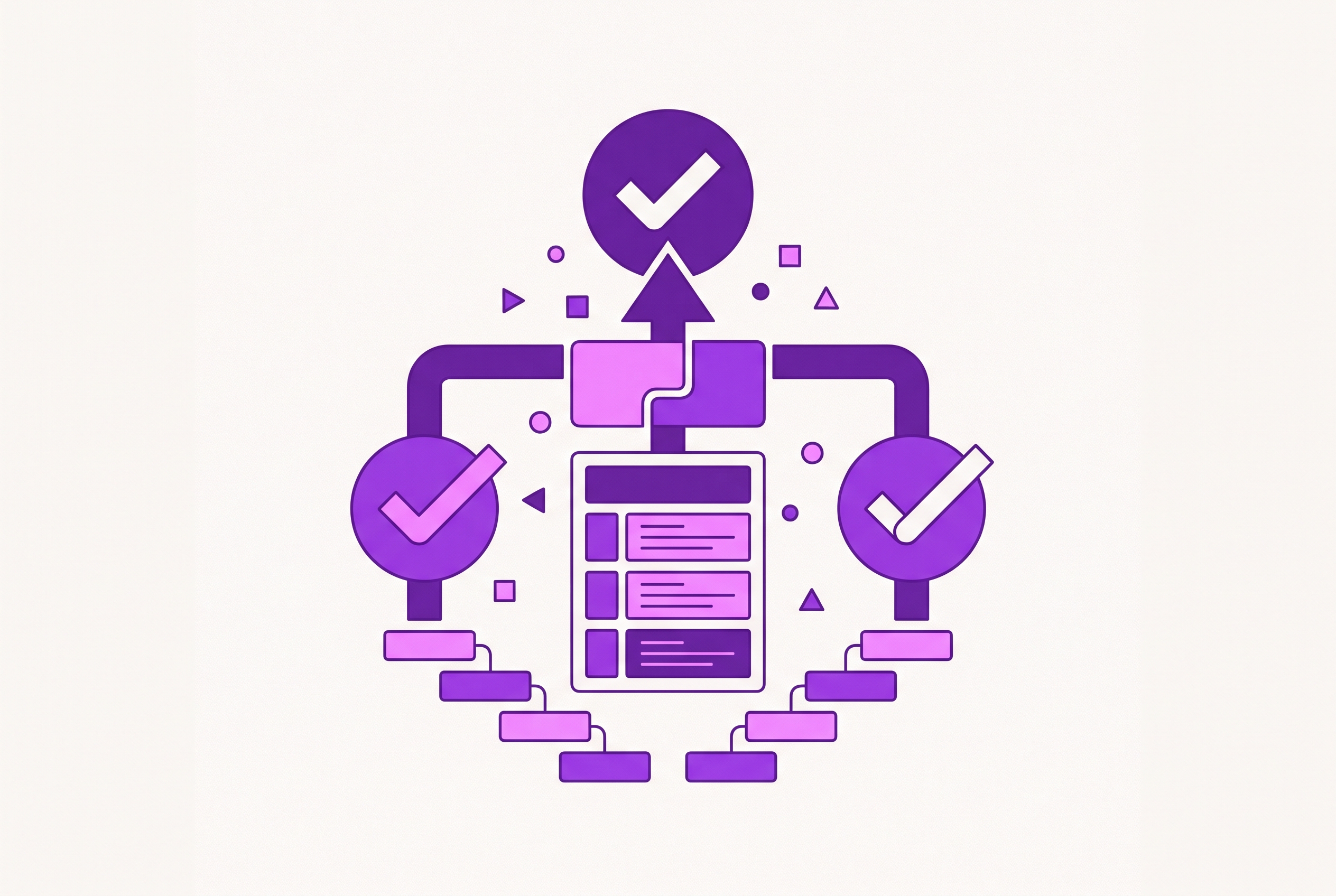
Qodo Merge uses specialized agents, a judge layer that filters findings, and a context engine that looks beyond the local diff to automate pull request review. Its value comes from connecting these layers into a review workflow that produces structured findings and proposed fixes. That architecture supports human judgment rather than replacing it, and its reach depends on deployment, configuration, and the context available.
Why automating PR review is harder than it looks
The criteria for finding a security flaw differ from those for spotting an inefficient algorithm, a missing null check, or gaps in test coverage. A single general-purpose model applied to a diff cannot reliably address that full range. Combining every task into one prompt also creates competition between categories, degrading the signal within each. The difficulty is not simply reading more code.
The diff itself is an incomplete account of the change. Code that looks correct locally can break a consuming service, violate conventions established through years of merged PRs, or fail to satisfy a linked ticket. Those failures depend on information outside the changed lines. A review system that cannot access that information has a structural blind spot, regardless of how carefully it examines the patch.
AI-generated code adds pressure to this existing gap. As the volume of code grows, human reviewers face more changes than they can examine with equal depth. Review must detect defects while enforcing standards that teams have developed over time, making the work both technical and organizational. Systems that can learn those standards are therefore becoming an operational need.
How the multi-agent pipeline divides the review work
Qodo’s multi-agent pipeline, introduced with Qodo 2.0 in February 2026, splits the review work into specialized tasks. Each agent has prompts and evaluation criteria tuned to its domain, so a single model no longer has to make every kind of judgment at once. Bug detection and security analysis can thus ask different questions about the same change. Specialization narrows the evaluation space for each agent.
That division addresses interference between review tasks. The heuristics that reveal a vulnerability are not the same as those that expose a missing null check, and neither fully describes how to assess test coverage. Dedicated evaluation reduces the extent to which findings in one category suppress findings in another. The Qodo 2.0 announcement frames the architecture as a response to the limitations of single-model review.
However, separate agents do not automatically produce a coherent review. Their conclusions can overlap, and their confidence can vary even when they identify the same underlying problem. Specialization helps the system find issues, but the findings still need to be brought together before a developer can act on them.
What the judge layer does before findings reach the pull request
The judge agent merges findings from the domain agents, removes duplicates, and filters low-confidence items before they reach the pull request. This is an active editorial step within the architecture. Without it, parallel analysis could expose reviewers to repeated descriptions of the same issue, each framed differently or supported with uneven confidence. The extra comments would erode the signal that specialization was intended to improve.
The review then groups findings by category and ranks them by severity. Each finding identifies a file and line, describes the issue, and supplies a suggested fix. That structure gives reviewers a location to inspect and a proposed response to evaluate.
Filtering improves precision, but it does not establish completeness. Recall remains below full coverage on live PRs, so the absence of a comment cannot prove that a change is sound. There is also a separate boundary that aggregation cannot cross. A judge can reconcile the findings it receives, but filtering alone cannot reveal a downstream dependency that the analysis never saw. That class of omission requires broader context.
How the context engine extends reasoning beyond the local diff
The context engine extends review across large codebases and repositories, addressing dependencies that local diff analysis cannot expose. Its role differs from the judge’s filtering work. A locally valid edit can then be assessed against the code that depends on it.
The PR Knowledge System, built on the context engine, also indexes past PR discussions and merged changes. The system uses that history to find team-specific best practices automatically, so its review draws on what the team has learned as well as generic coding conventions. Past decisions become relevant evidence for a new change. This extends context beyond code relationships into the standards under which the code was accepted.
Linked tickets supply another kind of evidence. When a PR is linked to a ticket, the tool pulls in its requirements and evaluates whether the change satisfies them. Review can therefore consider stated intent as well as implementation. These capabilities belong to the hosted commercial product, a separate offering from the self-hosted open-source core, PR-Agent. The distinction becomes especially significant for distributed systems, where a change in one repository can invalidate an assumption in another.
A concrete case — catching a cross-repo key rename before it causes failures
A key rename illustrates the boundary between local correctness and system compatibility. The changed repository can show a valid rename while a consuming repository remains pinned to the previous identifier. The evidence comes from how that downstream code uses the key. A reviewer restricted to the local diff cannot see it, so the compatibility problem remains outside the scope of the review.
Cross-repo context makes the relationship available for evaluation. The changed identifier can mismatch the consumer’s reference even when the renamed key’s local implementation is correct. No amount of closer reading of the producer’s diff can substitute for the missing consumer context.
The June 2026 cross-repo review capability brings this kind of check to multi-service architectures more broadly. The key-rename scenario illustrates how a changed identifier can break a consuming service, while leaving open whether every distributed-system failure is detectable. Its value is specific. It makes a dependency mismatch visible where single-repo analysis lacks the evidence needed to flag it, bringing a potentially breaking relationship into the review before the change is accepted.
Code that looks correct locally can break a consuming service, violate conventions established through years of merged PRs, or fail to satisfy a linked ticket.
How the self-learning rules layer and the /implement command close the feedback loop
Detection becomes more useful when the review workflow can turn a finding into a fix for evaluation. The /implement command converts a review discussion or comment into ready-to-commit code changes. The comment serves as the specification for the implementation. This closes the gap between a reviewer identifying a problem and a developer having a concrete change to assess, without equating generated code with an accepted fix.
The self-learning rules layer addresses a different gap. It observes how reviewers respond to suggestions over time and adapts the tool’s behavior toward team-specific norms. Standards do not have to remain fixed at the generic rules with which review began. The team’s handling of findings supplies a signal about which suggestions fit its practices.
This adaptation complements the historical knowledge available through the context engine. A finding can produce code for review, and the team’s response can inform later analysis. The strength of that feedback depends on the quality and consistency of the decisions available to learn from.
What the commands produce at each stage of the review cycle
The core review commands expose discrete outputs within the pull request workflow. /describe generates a structured PR description with a suggested title, PR type classification, high-level summary, and step-by-step changes walkthrough table. That artifact standardizes the information reviewers need before inspecting the code. It gives the change a readable outline rather than leaving reviewers to reconstruct its scope from the diff.
/review asks for analysis and feedback on the pull request, while /improve asks for code improvement suggestions. Their distinction separates assessment of the change from proposals for altering it.
For questions that arise during inspection, /ask provides interactive Q&A about the specific PR changes. Reviewers and contributors can probe the diff without leaving the review environment. A Chrome extension puts the chat-based interface directly in GitHub PR views, with private chat for each user in the file-changed tab. The extension is free to use with open-source repositories, while private repositories need a paid plan. That access policy is distinct from the managed product’s trial and subscription structure.
How deployment path and pricing affect which architectural layers a team can access
Deployment determines more than who runs the infrastructure. PR-Agent, the Apache 2.0 open-source option, provides the core commands /review, /describe, /improve, and /ask, but not the commercial context engine. It also excludes SOC 2 compliance, SSO, analytics dashboards, and managed infrastructure.
PR-Agent runs through Docker with user-supplied LLM API keys for OpenAI, Anthropic, or any OpenAI-compatible API. It supports GitHub, GitLab, Bitbucket, Azure DevOps, and Gitea. GitHub Actions provides another deployment path through a workflow file and API key secrets. A pre-built Action image handles Docker transparently, avoiding manual Docker setup or CI/CD reconfiguration beyond those additions.
The managed product adds context capabilities, automatic best-practices discovery, ticket integration, SSO, priority support, and analytics dashboards. It includes SOC 2 Type II compliance with zero data retention for analyzed code, which is discarded rather than stored, and 48-hour log retention for troubleshooting. Commercial availability is still tier-dependent. Enterprise adds organizational controls and cross-repo intelligence, with flexible single-tenant SaaS or on-premises deployment and quote-only pricing.
The managed product offers a 14-day trial with unlimited reviews and no credit card requirement, but no permanent free tier. The Team subscription, called the Pro Team plan, uses purchased credit packs pooled across the team. Credits do not roll over, and no annual commitment is required. The practical distinction is between access to core review commands, access to commercial context features, and access to Enterprise cross-repo capabilities.
Where the architecture’s limits sit and what teams should configure to work around them
The catch rate on live PRs remains meaningfully below full coverage, setting the central limit on reliance. The architecture can prioritize credible findings, but it cannot turn the absence of findings into a guarantee.
The practical response is to configure the tool around risk. Without configuration, the open-source version in particular can drift toward generic commentary that experienced reviewers learn to ignore. Teams should define what counts as high-risk and set severity thresholds and rules accordingly.
Processing time also imposes a trade-off. Specialized agents and context retrieval add latency compared with a single-prompt review, so teams with very high PR volume should measure performance against their review SLAs during the trial. Sparse PR discussions, few merged changes, or inconsistent commit practices reduce the benefit of the learning layer until useful history accumulates.
The appropriate operating role is triage and routing. Teams should use Qodo Merge to flag PRs that people need to inspect more closely and send high-confidence findings to senior reviewers. The architecture’s place in the workflow depends on people applying their review expertise to decisions left unresolved by automated findings.
Sources
- The Qodo Code Review experience - Qodo Documentation
Provided details on the core review commands (/review, /describe, /improve, /ask) and their outputs, including the structured PR description and walkthrough table.
- A Roadmap on Modern Code Review: Challenges and Opportunities
Supplied background on why automating PR review is structurally difficult, including the challenge of detecting defects while enforcing team standards.
- The Qodo Code Review experience - Qodo Documentation
Provided deployment configuration details including Docker setup, supported platforms, and LLM API key requirements for the open-source PR-Agent.
- Qodo Merge Is Now Part of the Qodo Platform
Provided information about the Qodo 2.0 release, the multi-agent pipeline introduction, and the rebranding context.
- AI Code Review
Provided details on the managed product's pricing tiers, trial terms, SOC 2 compliance, data retention policies, and enterprise deployment options.
- GitHub - Writesonic/qodo-pr-agent: 🚀 PR-Agent (Qodo Merge open-source): An AI-Powered 🤖 Tool for Automated Pull Request Analysis, Feedback, Suggestions and More! 💻🔍 · GitHub
Provided details on the open-source PR-Agent's Apache 2.0 license, supported platforms, and GitHub Actions deployment path.